
New York Philharmonic Young People's Concerts
- 1958 – 1972
- Ended
- 1 season
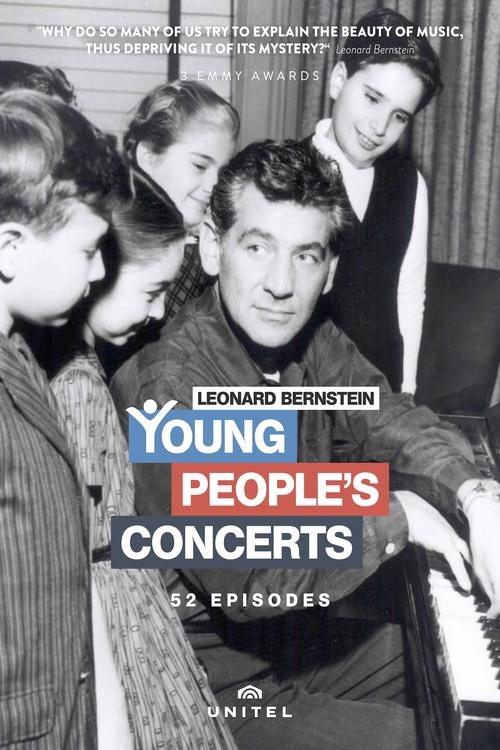
From 1958 through 1973, renowned conductor and composer Leonard Bernstein and the New York Philharmonic Orchestra thrilled audiences with wonderful concert experiences presented in a sparkling music-with-commentary format: the Young People's Concerts.
Latest: Season 1 · 1958
View all seasonsE1. What Does Music Mean?
Jan 18, 1958
Leonard Bernstein told the television audience at the start of the first Young People's Concert: "No matter what stories people tell you about what music means, forget them. Stories are not what music means. Music is never about things. Music just is. It's a lot of beautiful notes and sounds put together so well that we get pleasure out of hearing them. So when we ask, 'What does it mean; what does this piece of music mean?' we're asking a hard question. Let's do our best to answer it." During the course of this first program the New York Philharmonic performs portions of Rossini's William Tell Overture, Beethoven's Sixth Symphony, and Ravel's La Valse.
E2. What is American Music?
Feb 1, 1958
From Carnegie Hall, Bernstein discusses the origins and characteristics of American music. After an extended excerpt from George Gershwin's An American in Paris and a discussion of nationalistic and folk music, excerpts from compositions by American composers Edward MacDowell, William Schuman, Virgil Thomson, and others are performed. In closing Aaron Copland conducts parts of his own Third Symphony.
E3. What is Orchestration?
Mar 8, 1958
After brief introductory remarks, Bernstein conducts the finale of Rimsky-Korsakov's Capriccio espagnol and then explains what a composer must know in order to orchestrate music successfully. He compares the flute to the trumpet, and the clarinet to the viola, with examples from Debussy and Gershwin. After asking the audience to sing two notes in a variety of ways, he contrasts the families of instruments that compose an orchestra, using excerpts from Prokofiev, Hindemith, Mozart and others to illustrate, and ends with Ravel's Bolero.
E4. What Makes Music Symphonic?
Dec 13, 1958
Using the examples of Mozart's Jupiter Symphony and Tchaikovsky's Fourth Symphony, Bernstein demonstrates the techniques of repetition and variation int he development of symphonic music. After conducting part of Tchaikovsky's Romeo and Juliet, he asks the audience to sing "Frére Jacques," demonstrating the uses of sequence and imitation in symphonic composition. The final movement of Brahm's Second Symphony is then analyzed and played.
E5. What is Classical Music?
Jan 24, 1959
Bernstein conducts Handel's Water Music and cites it as an indisputable example of classical music. "Exact" is the word that best defines classical music, Bernstein says, and he demonstrates with musical illustrations from Bach's Fourth Brandenburg Concerto, Mozart's Concerto No. 21 in C Major and The Marriage of Figaro, and Haydn's Symphony No. 102. The decline of classical music at the end of the eighteenth century is tied to Beethoven's innovations and the Romantic movement, and Bernstein conducts Beethoven's Egmont Overture.
E6. Humor in Music
Feb 28, 1959
Using excerpts from Shostakovich, Mahler, Haydn and others Bernstein demonstrates how a "serious" composition can take an unexpected humorous turn. Prokofiev's Classical Symphony is played in its entirety.
+47 more episodes — open all seasons to browse every episode.