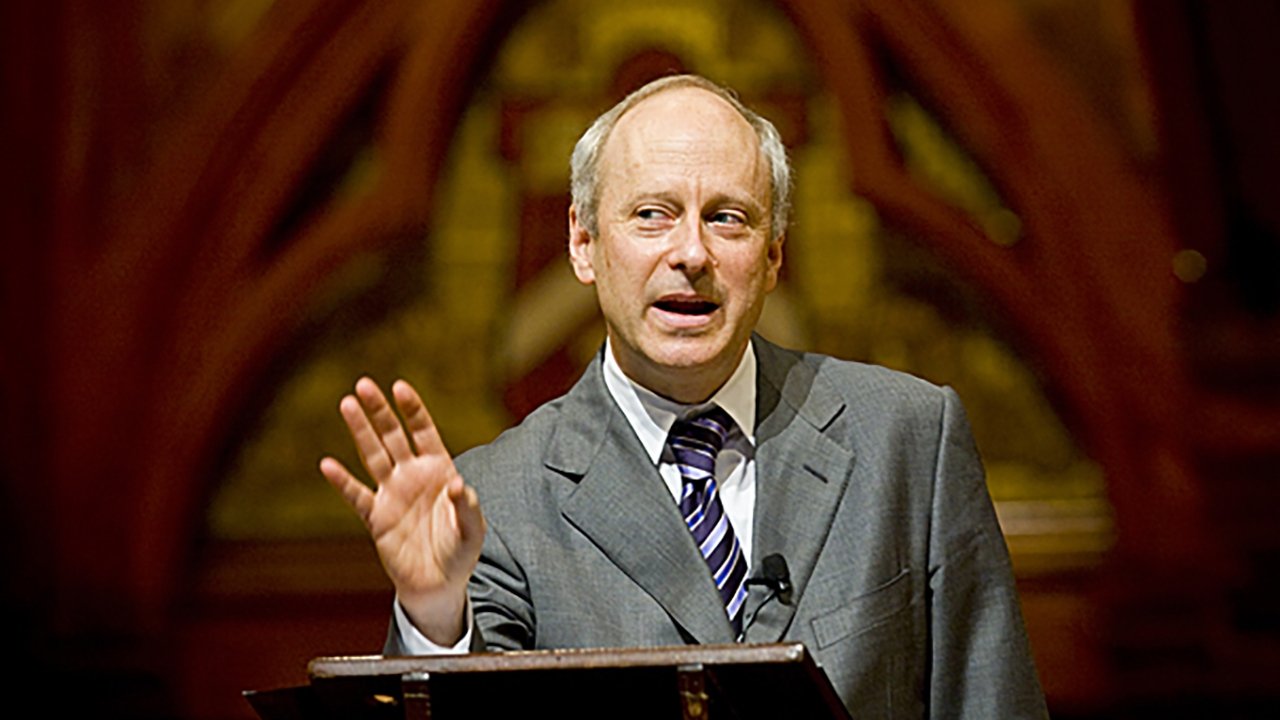

Justice with Michael Sandel
- 2009
- Returning Series
- Talk
- 1 season
- 9.0/10
Justice is the first Harvard course to be made freely available online and on public television. In this 12-part series, college professor Michael Sandel challenges us with hard moral dilemmas and invites us to ponder the right thing to do-in politics and in our everyday lives.
Latest: Season 1 · 2009
View all seasonsE1. The Moral Side of Murder/The Case for Cannibalism
Sep 9, 2009
If you had to choose between (1) killing one person to save the lives of five others and (2) doing nothing even though you knew that five people would die right before your eyes if you did nothing—what would you do? What would be the right thing to do? Thats the hypothetical scenario Professor Michael Sandel uses to launch his course on moral reasoning. After the majority of students votes for killing the one person in order to save the lives of five others, Sandel presents three similar moral conundrums—each one artfully designed to make the decision more difficult. As students stand up to defend their conflicting choices, it becomes clear that the assumptions behind our moral reasoning are often contradictory, and the question of what is right and what is wrong is not always black and white.
E2. Putting a Price Tag on Life/How to Measure Pleasure
Sep 9, 2009
Today, companies and governments often use Jeremy Benthams utilitarian logic under the name of cost-benefit analysis. Sandel presents some contemporary cases in which cost-benefit analysis was used to put a dollar value on human lie. The cases give rise to several objections to the utilitarian logic of seeking the greatest good for the greatest number. Should we always give more weight to the happiness of a majority, even if the majority is cruel or ignoble? Is it possible to sum up and compare all values using a common measure like money?
E3. Free to Choose/Who Owns Me?
Sep 9, 2009
Sandel introduces the libertarian conception of individual rights, according to which only a minimal state is justified. Libertarians argue that government shouldnt have the power to enact laws that 1) protect people from themselves, such as seat belt laws, 2) impose some peoples moral values on society as a whole, or 3) redistribute income from the rich to the poor. Sandel explains the libertarian notion that redistributive taxation is akin to forced labor with references to Bill Gates and Michael Jordan.
E4. The Land is My Land/Consenting Adults
Sep 9, 2009
The philosopher John Locke believes that individuals have certain rights so fundamental that no government can ever take them away. These rights—to life, liberty and property—were given to us as human beings in the the state of nature, a time before government and laws were created. According to Locke, our natural rights are governed by the law of nature, known by reason, which says that we can neither give them up nor take them away from anyone else. Sandel wraps up the lecture by raising a question: what happens to our natural rights once we enter society and consent to a system of laws?
E5. Hired Guns?/For Sale: Motherhood
Sep 9, 2009
During the Civil War, men drafted into war had the option of hiring substitutes to fight in their place. Professor Sandel asks students whether they consider this policy just. Many do not, arguing that it is unfair to allow the affluent to avoid serving and risking their lives by paying less privileged citizens to fight in their place. This leads to a classroom debate about war and conscription. Is todays voluntary army open to the same objection? Should military service be allocated by the labor market or by conscription? What role should patriotism play, and what are the obligations of citizenship? Is there a civic duty to serve ones country? And are utilitarians and libertarians able to account for this duty?
E6. Mind Your Motive/The Supreme Principle of Morality
Sep 9, 2009
Professor Sandel introduces Immanuel Kant, a challenging but influential philosopher. Kant rejects utilitarianism. He argues that each of us has certain fundamental duties and rights that take precedence over maximizing utility. Kant rejects the notion that morality is about calculating consequences. When we act out of duty—doing something simply because it is right—only then do our actions have moral worth. Kant gives the example of a shopkeeper who passes up the chance to shortchange a customer only because his business might suffer if other customers found out. According to Kant, the shopkeepers action has no moral worth, because he did the right thing for the wrong reason.

+6 more episodes — open all seasons to browse every episode.
More like this

Do-ol Ah-in Going All Directions· 2019

Great Minds· 2021
Comedians Giving Lectures· 2019
Transformations of Myth Through Time· 1989
The Richard Dimbleby Lecture· 1972
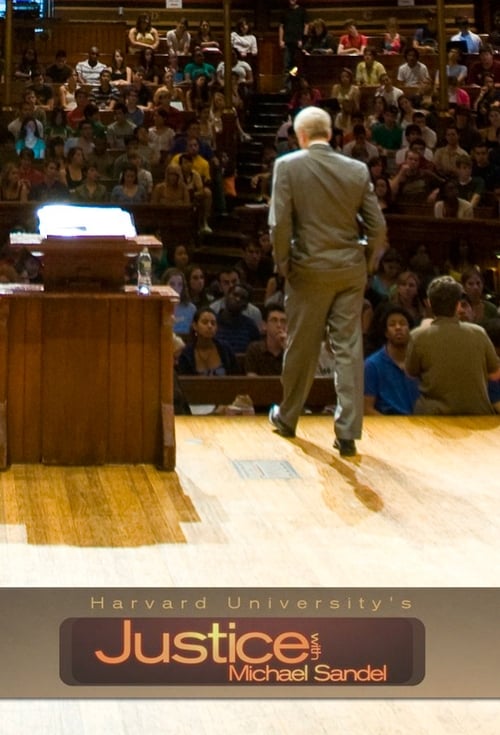
Justice· 2009
Friends from College· 2017
Mythos

Lessons in Chemistry· 2023
Anatomy for Beginners· 2005
Frasier· 2023
The Last Convertible· 1979

Rainbow Woman· 2020

Get It Beauty 2019· 2019

This Time with Alan Partridge· 2019

SKY Muscle· 2019

Berg & Talk· 1994
Inside Brüssel· 2012